How I Improved Listening and Reading: My Practice Strategy
How often I reviewed the question bank, what I prioritised, and the Listening and Reading scores I received
What mattered most for me
For Listening and Reading, repeated practice made the biggest difference.
My listening and reading scores
My listening and reading scores across four exams were:
- Listening — 547/C1 → 644/C2 → 505/C1 → 644/C2
- Reading — 518/C1 → 690/C2 → 690/C2 → 646/C2
From my first through fourth exams, listening and reading stayed at C1 or above. The TCF Canada question bank is still being updated, and new questions do appear, but the update pace has been relatively slow. The existing bank can therefore still provide useful coverage, which is why targeted practice remains worthwhile—without treating any exact question as guaranteed to repeat.
My practice strategy
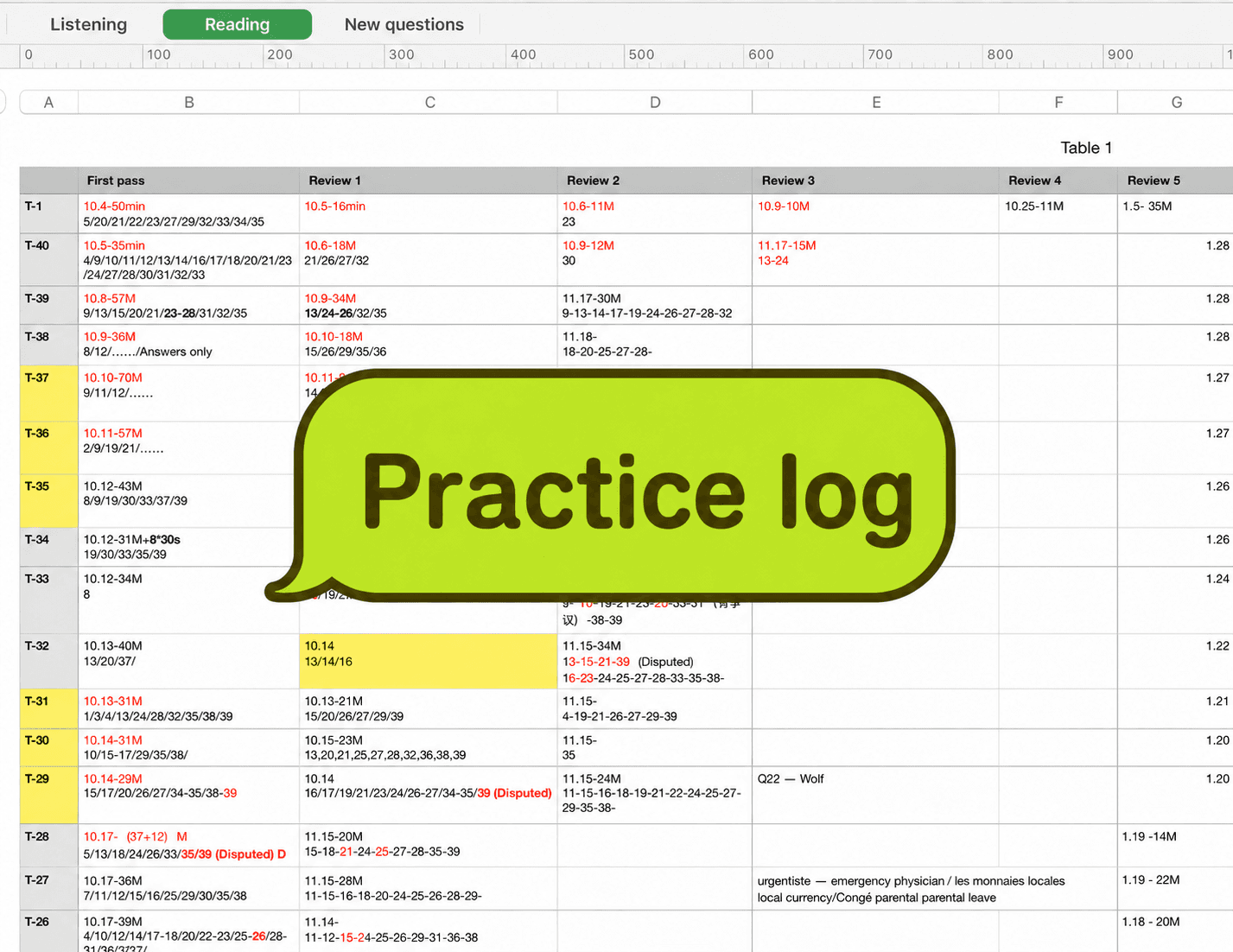
Having a question bank helps, but it is still easy to spend time on the wrong questions. Later in my preparation, I made a workbook so I could get through review rounds faster.
Now let us look at the structure of the listening and reading questions. The question bank grew from 39 sets last year to more than 40 sets, while the number of questions in an exam has not changed. The difficulty rises from A1 to C2: there are 10 A-level questions, 20 B1/B2 questions—the largest share—and 9 C-level questions. Your strategy can depend on your goal:
- If you only need to pass listening and reading: focus on the A and B-level questions. You do not need to master every C-level question; put more of your time into writing and speaking.
- If you also want high scores in listening and reading: work through every question from beginning to end, especially the C-level questions, until they are thoroughly familiar. The challenge is balancing this with writing and speaking, which also require more time.
My review rhythm
Across my four exams, I usually completed two or three full rounds of listening and reading before each exam, then did one quick review on exam day. That means I probably went through the material 10–12 times in total. Later, my speed kept increasing: sometimes seeing a question or hearing the beginning of an audio clip was enough for me to know which answer to choose.
On a first pass, it is normal for one set to take more than an hour. My suggestion is to truly master the basic questions (A1–B1), try to solve and understand the B2 questions yourself where possible, and simply memorise the answers when a question is too difficult. For exam preparation only, this approach can be practical; for genuine language learning, you still need steady and systematic work.
Why the basic questions deserve serious practice
Why do I recommend taking the basic questions seriously? First, they build a real foundation for your preparation. Many sentences in the reading questions are useful models for writing, and every listening question can be treated as a speaking examiner asking you something. They train your ear. If you only memorise answers, you may move faster on the surface, but you will get much less help with writing and speaking.
Once you become familiar with the questions, you can put this review after writing or speaking practice and treat it as a reward. Getting an answer right—or recognising one you remember—can give your sense of progress a real boost.
It is not easy at the beginning, but it gradually gets better if you keep going. I am saying this to you, and to myself.
Personal study notes, not official TCF guidance.